
Reading the Work: Anne’s "Pinch Out / Good Trip"
As a satellite exhibition of Kyōto YouMe Triennale 2026, an international art exhibition opening in Kyoto on October 9, we are pleased to present There, All Along, a solo exhibition by visual artist Anne.
Anne does not speak extensively about the work. This leaves room for each viewer to engage with the work freely and discover meaning from their own perspective.
From the works presented in this exhibition, we would like to focus on Pinch Out / Good Trip. Taking inspiration from Yokoyama Taikan’s Willow Shade, this work invites us to explore its background and underlying structure from Gallery Rin’s perspective.
Text:Ryohei Miki, Producer of Gallery Rin
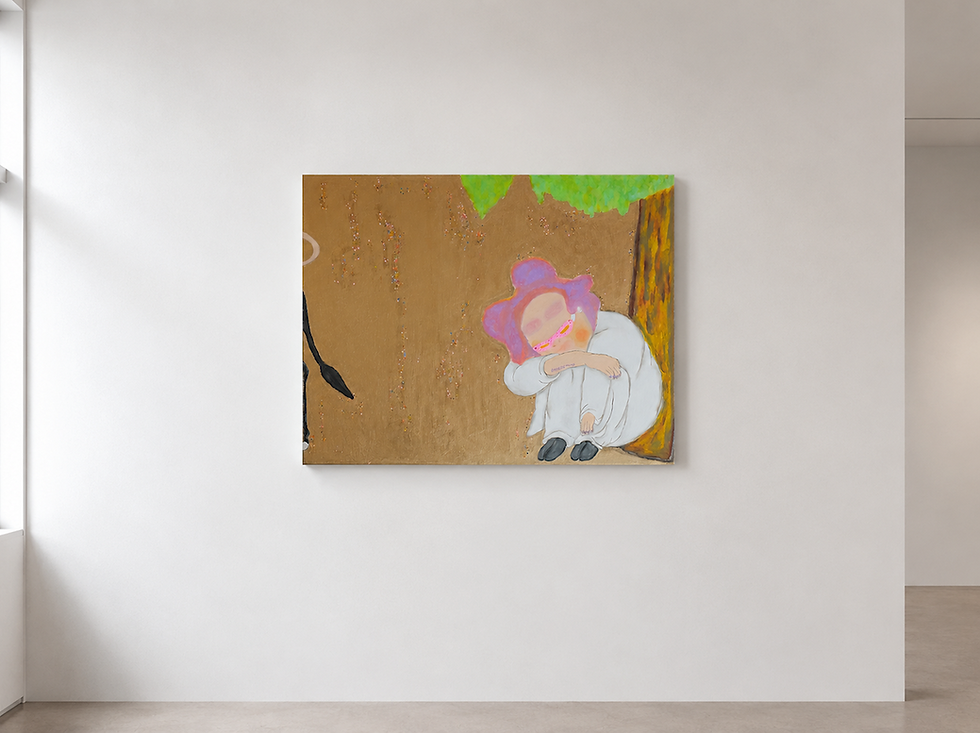
Pinch Out / Good Trip is a work reconstructed through the bold cropping and enlargement of a detail from Yokoyama Taikan’s Willow Shade. By extracting a specific fragment from the “whole” of a painting, the work calls into question the very act of looking at a painting.
The relationship between Willow Shade and Four Seasons Landscape Screens, attributed to Shūbun, has been noted. Considering how a scene depicted in Shūbun’s composition was developed further in Taikan’s Willow Shade, we can see an approach to artistic creation in modern Japanese painting in which artists studied earlier works, incorporated particular motifs and compositions, and transformed them into their own visual language.
Of course, it is important to be cautious about directly describing this process as “sampling” in the contemporary sense. Learning from and transforming earlier paintings is deeply rooted in the long tradition of Japanese painting.


However, if we reconsider this relationship through the contemporary concept of “sampling,” the work reveals an even more intriguing structure.
Namely:
Four Seasons Landscape Screens, attributed to Shūbun
→ Yokoyama Taikan’s Willow Shade
→ Anne’s Pinch Out / Good Trip
A chain of paintings giving rise to other paintings.
In Pinch Out / Good Trip, only a fragment of Willow Shade is extracted: the donkey’s tail and a young figure leaning against a tree. Originally a small scene within a much larger composition, this fragment is detached from its surrounding landscape and enlarged, becoming a new “whole” in its own right.

Here, “sampling” does not simply mean borrowing something from an existing painting. It is an act of selection and transformation: deciding what to choose, where to crop, how far to enlarge, and what to retain. Through these decisions, something that was once merely a fragment of an original work is shifted to the center of an entirely new one.
In this sense, the work samples Taikan’s Willow Shade while also sampling the very mechanism through which paintings absorb, transform, and pass on elements of earlier paintings to those that follow.
The title Pinch Out evokes the gesture of zooming in on an image using a smartphone or tablet screen.
Yet the act of pinching out in this work is more than a simple digital operation.
By enlarging a fragment of Willow Shade, something that was once a “part” becomes a new “whole.” At the same time, viewers looking at this new whole may begin to perceive the presence of the original Willow Shade within it.
A “part within a whole” becomes a “new whole,” and from this new whole, the original composition comes back into awareness.
This back-and-forth movement is one of the work’s visual devices.

What emerges within this structure is a gold background, scattered with colorful dots.
The gold ground evokes the visual language of Japanese painting, particularly that of modern Japanese painting, while the scattered dots of color suggest pixels or digital noise. By bringing together fragments of figures and a donkey drawn from a classical painting with visual elements reminiscent of digital imagery, the work layers different eras of visual experience within a single composition.
The words Good Trip introduce another dimension to this visual journey.
Here, “trip” does not simply refer to travel. As a fragment is enlarged, the appearance of a familiar painting gradually changes, and the viewer’s gaze, too, moves toward a place different from that of the original composition.

Alongside the sensation of entering into the painting, the work also carries an almost intoxicating quality, as though the contours of reality and the nature of perception itself have begun to shift ever so slightly.
Pinch Out and Good Trip bring together two experiences: the digital manipulation of an image and the transformation of perception.
Seen in this light, the work is not simply a contemporary reinterpretation of Taikan’s Willow Shade.
From Shūbun to Taikan, and from Taikan to Anne: earlier paintings are referenced, fragments are extracted and transformed, and new compositions emerge. Within this chain, the boundaries between the “original” and the “quoted,” between “part” and “whole,” and between “past” and “present” begin to blur.
Using the distinctly contemporary gesture of enlarging a fragment as its point of departure, Pinch Out / Good Trip makes visible the relationship between inheritance and transformation that exists throughout the history of painting.
To extract a fragment from a painting does not mean losing the painting itself. Rather, as the extracted fragment becomes a new whole, the original painting, too, emerges again in a new form.
The work presents this ongoing movement back and forth as a single “trip.”


Comments